
Youth Shirt Sizes by Age
Find the youth shirt size that usually fits by age, height or chest measurement. Enter your child's age and measurements for a suggested size, then check the chart for youth XS to XL, numbered sizes 4 to 20, and when adult sizes take over.
- Free to use
- No sign-up
- Runs in your browser
Find a youth shirt size
Youth shirt size chart
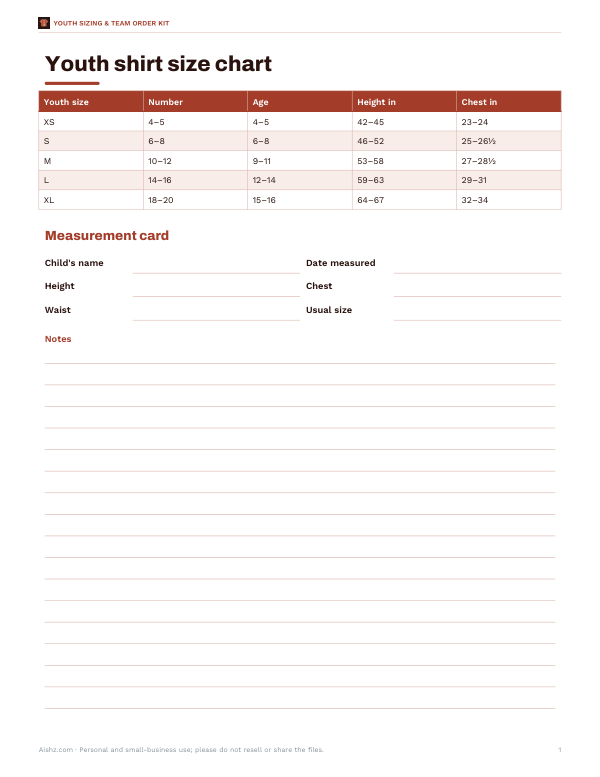
| Youth size | Number size | Typical age | Height (in) | Height (cm) | Chest (in) | Chest (cm) |
|---|---|---|---|---|---|---|
| XS | 4–5 | 4–5 years | 42–45 | 107–114 | 23–24 | 58–61 |
| S | 6–8 | 6–8 years | 46–52 | 117–132 | 25–26½ | 64–67 |
| M | 10–12 | 9–11 years | 53–58 | 135–147 | 27–28½ | 69–72 |
| L | 14–16 | 12–14 years | 59–63 | 150–160 | 29–31 | 74–79 |
| XL | 18–20 | 15–16 years | 64–67 | 163–170 | 32–34 | 81–86 |
Youth Sizing & Team Order Kit
A printable youth size chart, a measurement card for parents and an Excel team shirt order form that tallies sizes automatically.
- Team / class shirt order form (XLSX, PDF)
- Size chart & measurement card (PDF, DOCX)
Formats: XLSX, PDF, DOCX. Instant download after payment (link valid 72 hours, up to 5 downloads). AI-assisted: the templates were drafted with AI help and reviewed and laid out before publishing.
$5.00 USD, one-time
- Instant download
- 7-day refund
- Secure checkout by Stripe
7-day money-back guarantee. Full refund within 7 days of purchase, even after you download.
Full refund within 7 days — see the refund policy and license.
Free printables
Single sheets you can print right now, no sign-up. The full pack adds every sheet in one download plus the editable files.
How youth shirt sizes work
Youth (or “big kids”) sizes usually follow the toddler range (2T–5T) and run from about age 4 to 16. Most brands label them with letters — XS, S, M, L, XL — and many also give a number or a range of numbers such as 6–8 or 10–12. The numbers originally corresponded roughly to age, but children of the same age vary a lot, so height and chest measurements are much better guides. After youth XL, most teenagers move into adult sizes, where a youth XL is often close to an adult small.
Measure instead of guessing
- Height: have your child stand straight against a wall without shoes; mark the top of the head with a book held level and measure from the floor.
- Chest: wrap a soft tape measure around the fullest part of the chest, under the arms and across the shoulder blades, keeping it level and snug but not tight.
- Compare: use the chart above or the brand's own chart. If measurements fall in two sizes, choose the larger.
Measure every few months — children can grow several inches in a year during growth spurts, and sizes that fit in September can be short by spring.
Letters, numbers and brands
Brands map letters to numbers differently. One store's youth medium might be labelled 8, another's 10–12, and fit varies by cut: athletic brands often run slimmer, while basic cotton tees are cut more generously. Cotton shirts can also shrink in the first wash, particularly in length. When buying online, look for the brand's size chart with body measurements, and read reviews that mention whether the item runs small or large.
Worked example
A 9-year-old who is 52 inches tall with a 27-inch chest fits within youth M (sizes 10–12) by age and chest, but is at the top of youth S by height. Following the rule that the larger measurement decides, youth M is the suggested size. If you want room to grow for a school year, the calculator moves up to youth L. For a team shirt ordered once for a whole season, sizing up is usually the safer choice.
Ordering shirts for teams, camps and schools
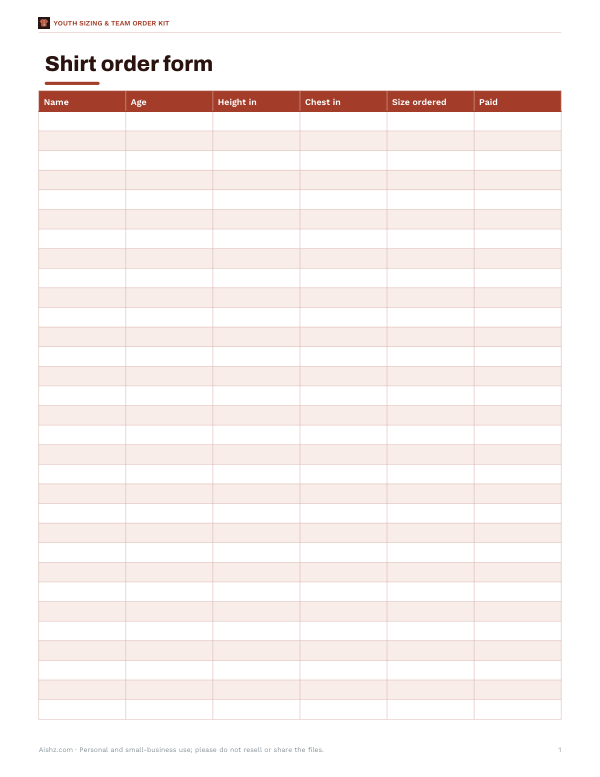
- Collect sizes rather than ages on the order form — ask parents to pick from the chart.
- Order a few extra in the most common sizes (usually youth M and L) for late sign-ups.
- Include adult S and M for older children and coaches.
- For printed shirts, note that heavy prints and screen-printing inks stiffen the fabric; a size up can be more comfortable.
- Keep a size list on file for reorders.
When to switch to adult sizes
Most children move into adult sizes around ages 13 to 16, or when their chest is over about 34 inches or height over about 5 feet 7 inches. Adult small shirts are usually longer in the body and wider at the shoulders than youth XL, and unisex adult sizes are cut on a men's block, so a slim teenager may still prefer youth XL for a few more years. Try both if you can.
Youth versus toddler and adult sizes
| Range | Labels | Typical ages |
|---|---|---|
| Toddler | 2T, 3T, 4T, 5T | 2–5 years |
| Youth / kids | XS–XL or 4–20 | 4–16 years |
| Adult unisex | XS–3XL | Teens and adults |
The ranges overlap: a small 5-year-old may still wear 5T, while a tall one needs youth XS. Toddler sizes have more room for diapers and a shorter body; youth sizes are longer and narrower.
Growth, shrinkage and buying ahead
Children tend to grow fastest around infancy and again during the teenage growth spurt, and many grow a couple of inches a year in between. If you are buying school uniform shirts in summer for a whole school year, choosing the next size up with a little extra length usually works better than an exact fit. Wash new cotton shirts once in cold water before school starts: most shrinkage happens in the first hot wash and tumble dry, and washing cold and line drying keeps shirts closer to their original size.
Frequently asked questions
What size is a youth medium?
Usually sizes 10–12, for children about 9–11 years old, 53–58 inches tall with a 27–28½ inch chest.
Is youth XL the same as adult small?
They are close in chest width, but adult small is usually longer and broader in the shoulders.
What size shirt for an 8-year-old?
Often youth S (6–8) or youth M (10–12) depending on height and chest — measure to be sure.
Should I size up for growth?
For long-term wear or team shirts, sizing up one size is common. For fitted sports tops, go by the current measurement.
What does youth 10/12 mean?
A combined size that fits children who would wear size 10 or size 12 — typically youth medium.
Do youth shirts shrink?
100% cotton shirts can shrink a little, mostly in length, in the first hot wash. Wash cold to minimise it.